
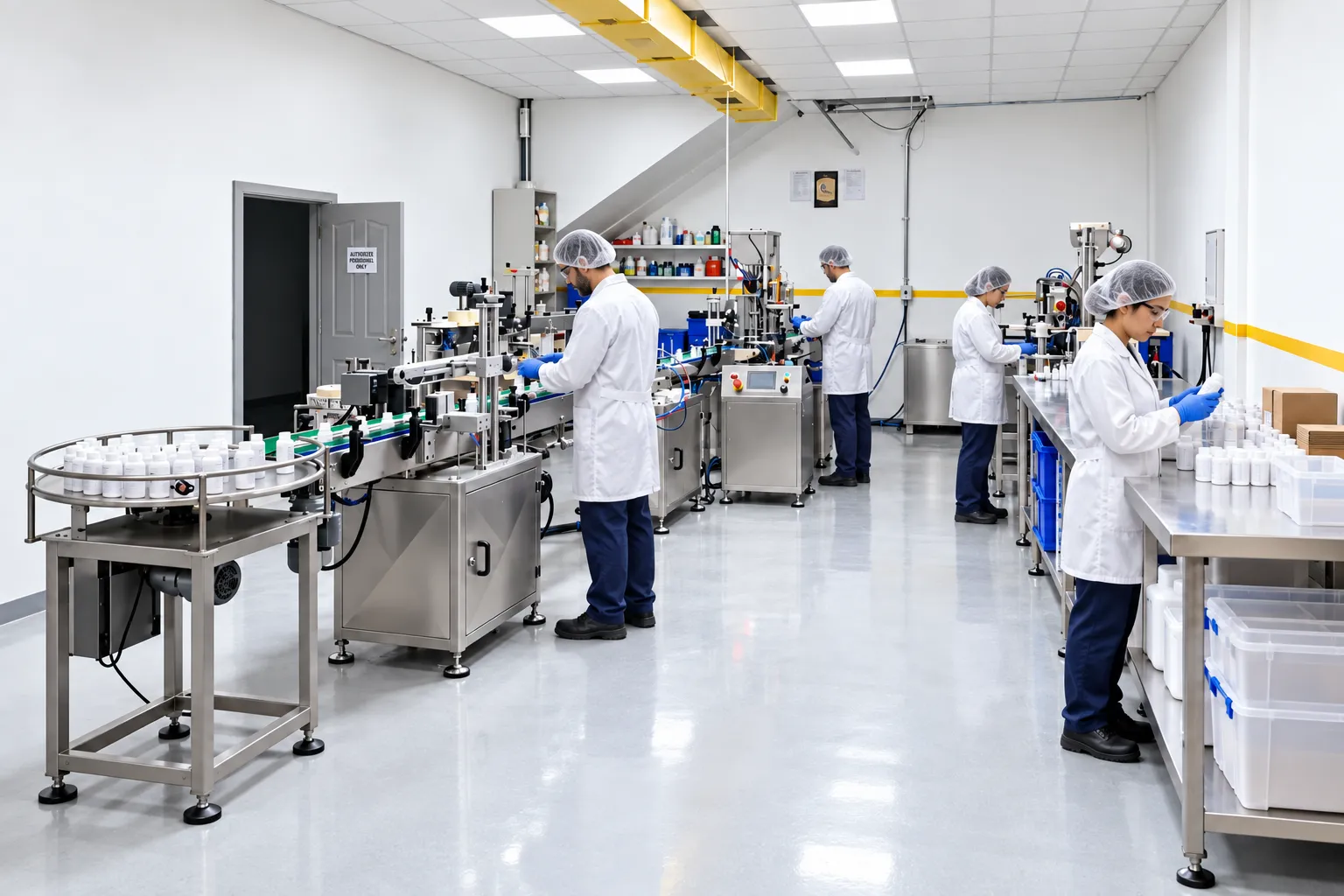
Cosmetic contract manufacturing means a brand has its product made by a manufacturer that specializes in this work, rather than in its own facility. The brand manages the product concept, packaging, sales and marketing. The contract manufacturer, with its machines, team and experience, takes on part or all of the production. A large share of the cosmetic brands you see on store shelves work this way.
In this article, we explain what stages cosmetic contract manufacturing involves, who it makes sense for, how the process unfolds and what you should keep in mind before you get started.
What stages does cosmetic contract manufacturing cover?
"Contract manufacturing" is not a single job; it is a chain of consecutive steps. Some companies handle the entire chain, while others take on only certain links. Before choosing who to work with, you need to know which stages you actually need.
1. Formulation and bulk production
This is where the product's formula is developed and produced in large vessels as "bulk." The shampoo, cream or cologne itself comes into being at this stage. The formula may belong to the brand, or one of the manufacturer's ready-made formulas may be chosen.
2. Filling
This is the filling of the bulk product into bottles, tubes, jars, pump or spray packaging. The product's consistency determines the filling method: a water-thin cologne and a thick cream are not filled on the same machine with the same settings. We cover the details on our cosmetic contract filling page.
3. Labeling
This is the application of front and back labels to the packaging. In batches of thousands of units, keeping every label at the same position and free of bubbles is only possible with a machine. It is a step that directly shapes the first impression on the shelf; see contract labeling.
4. Packaging
This involves placing products in individual boxes, assembling sets and arranging them into shipping cartons. The packaging format changes depending on whether the product is headed for retail shelves, e-commerce or wholesale; see contract packaging.
For example, a brand that already has its formula and bulk product can work with a contract manufacturer for filling, labeling and packaging only. A brand whose product arrives ready-made can also order labeling only or packaging only.
Who is contract manufacturing a good fit for?
- New cosmetic brands. It is the fastest way to bring a product to market without investing in machinery, production lines and staff.
- Brands expanding their product range. A company that makes creams in its own facility can outsource a spray or cologne instead of setting up a separate line for it.
- E-commerce and social media brands. Teams that focus on sales and marketing and want to leave production to the specialists.
- Corporate and hotel projects. Businesses that want their own branded shampoo, liquid soap or amenity set.
- Manufacturers at full capacity. Companies that want to outsource excess orders during peak season.
Benefits of cosmetic contract manufacturing
Lower investment. The cost of filling machines, a labeling line, warehousing and staff is lifted off the brand. Capital can go into product development, packaging and marketing instead.
Faster time to market. Building a facility takes months, while production on an existing line can start much sooner.
You can start with small batches. Many contract manufacturers work with low minimum order quantities for first runs. You do not have to risk thousands of units of stock before demand is clear. For example, we accept batches starting at 1,000 units.
You benefit from experience. Knowing which packaging leaks, which label peels off in humidity and which consistency works with which pump is learned on the shop floor. A contract manufacturer brings that knowledge to every new job.
Scaling is easier. When sales grow, you increase your batch size instead of buying new machines.
Things to watch out for
The convenience of contract manufacturing does not remove certain responsibilities. Before you start, you should clarify the following:
- Division of work. Who will supply the formula, bulk product, packaging and labels? Who will carry out each stage? Every point left unclear comes back as a problem at delivery.
- Regulatory responsibility. In Turkey, cosmetic products fall under the Turkish Cosmetics Regulation. Before a product goes on the market, it must be notified to the Product Tracking System (ÜTS), and a product information file and safety assessment must be prepared. Discuss from the outset who holds these obligations (usually the brand owner, acting as the "responsible person"). Follow the announcements of the Turkish Medicines and Medical Devices Agency (TİTCK) for the current rules; this article is not legal advice.
- Label content. A cosmetic label must include mandatory elements such as the ingredient list, nominal quantity, batch number, shelf life and the responsible person's details. Have your label design checked for regulatory compliance before sending it to print.
- Samples and trial runs. Approving the packaging, fill level and label alignment on a sample before the large batch prevents surprises.
- Confidentiality. If you are sharing your formula or packaging design, signing a non-disclosure agreement makes things clear for both sides.
How does the process work, step by step?
- Initial meeting. You discuss your product, your packaging, your target quantity and which stages you need.
- Preliminary work. A filling method suited to the product's consistency and packaging is chosen; labeling and packaging details are finalized.
- Quote and approval. You agree on the unit price, batch size and delivery plan.
- Sample. If needed, a small trial is run and the result is approved together.
- Production. Filling, labeling and packaging are carried out in sequence. When done in the same facility, there is no transport or waiting time in between.
- Delivery. The batch is counted, packed into cartons and delivered. Repeat orders continue with the same setup.
What determines the price in contract manufacturing?
The unit price is not a single number; it is made up of several variables:
- Batch size. Since the machine setup is done once per batch, the unit cost falls as the quantity rises.
- Product consistency and packaging type. Pump, spray or narrow-neck packaging fills more slowly.
- Number and format of labels. A single label versus front and back labels, or a round bottle versus square packaging, do not run at the same speed.
- Packaging scope. Boxing, set assembly and custom carton layouts add labor.
- Who supplies the materials. Whether the packaging and labels are sourced by the brand or by the manufacturer.
That is why, for an accurate quote, you need to share your product, your packaging and your target quantity together.
Frequently asked questions
Can I launch my own brand through contract manufacturing?
Yes. This is the most common use of contract manufacturing: the product comes off the manufacturer's line with your brand's label. For a step-by-step roadmap, see our article on starting your own cosmetics brand.
What is the minimum order quantity?
It varies from company to company. We work with batches starting at 1,000 units, and our daily capacity is up to 15,000 units.
Can I order filling only, or labeling only?
Yes. The stages can also be ordered independently of one another. A product filled elsewhere can be labeled or packaged only.
What should I look for when choosing a contract manufacturer?
We cover topics such as capacity, minimum quantity, the product and packaging types they work with, the sampling process and communication in detail in our article 10 questions to ask when choosing a contract filling company.
Summary
Cosmetic contract manufacturing is a division of work in which the brand focuses on the product and the market, and the manufacturer focuses on production. Set up correctly, it reduces the investment burden, speeds up time to market and lets you start with small batches. The key to a successful partnership is a division of work that is clear from the start and production approved on a sample.
At Velioğlu Kozmetik, in our facility in Esenyurt, İstanbul, we provide filling, labeling and packaging for shampoos, shower gels, liquid soaps, creams, lotions, colognes and sprays. Share your product and your target quantity to get a quote from us.